

How to Evaluate Electric Three-Wheel Bike Listings Before You Request a Quote matters because readers need a clear, practical answer to electric three wheel bike for sale. This article breaks the topic into Prerequisites: Tools, Budget, and Time You Need Before You Start, Step 1: Define Your Duty Cycle, Payload, and Use Case Before Comparing Listings, Step 2: Confirm Legal Classification and Certifications for Your Jurisdiction so the reader can move from understanding to decision-making without fluff.
Prerequisites: Tools, Budget, and Time You Need Before You Start
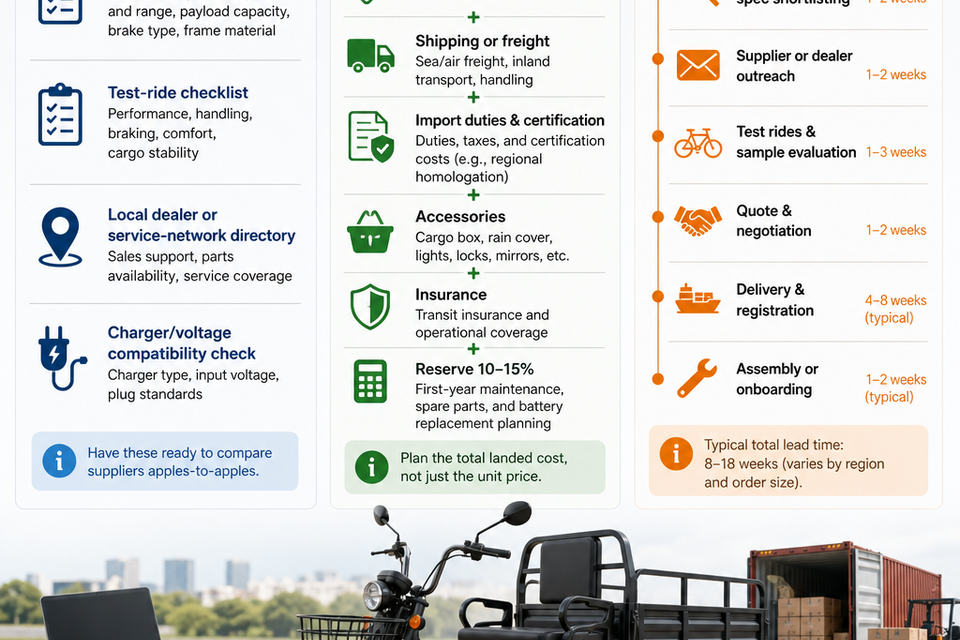
Before you request quotes on an electric three-wheel bike for sale, gather your spec requirements, total landed budget, and a realistic purchase timeline. Buyers who define these three inputs up front compare suppliers more accurately and avoid surprise costs at delivery.
Before you request quotes, set up three things: a shared comparison sheet, a reserved budget, and two to four weeks of evaluation time. Without them, you will compare listings that don’t match.
Tools
- A shared spreadsheet with one column per supplier and a row for each cost variable.
- A notes template for supplier answers, so every reply lands in the same format.
- Access to a customs broker or freight forwarder before you commit.
Budget
- Reserve funds for 2-3 sample units or sample-testing fees.
- Get quotes for third-party inspection. Costs range from a few hundred to a few thousand dollars, depending on scope.
- Include a customs-broker consultation.
Time Plan two to four weeks. Regulatory and landed-cost checks take the longest.
Don’t rank suppliers by FOB price alone. A low FOB quote can cost more per deployed unit once MOQ tiers, freight, duties, and battery shipping surcharges are added. Fill in your worksheet first, then request itemized quotes that match its rows. You can also browse the electric three wheel bike for sale range to set your baseline.
Step 1: Define Your Duty Cycle, Payload, and Use Case Before Comparing Listings
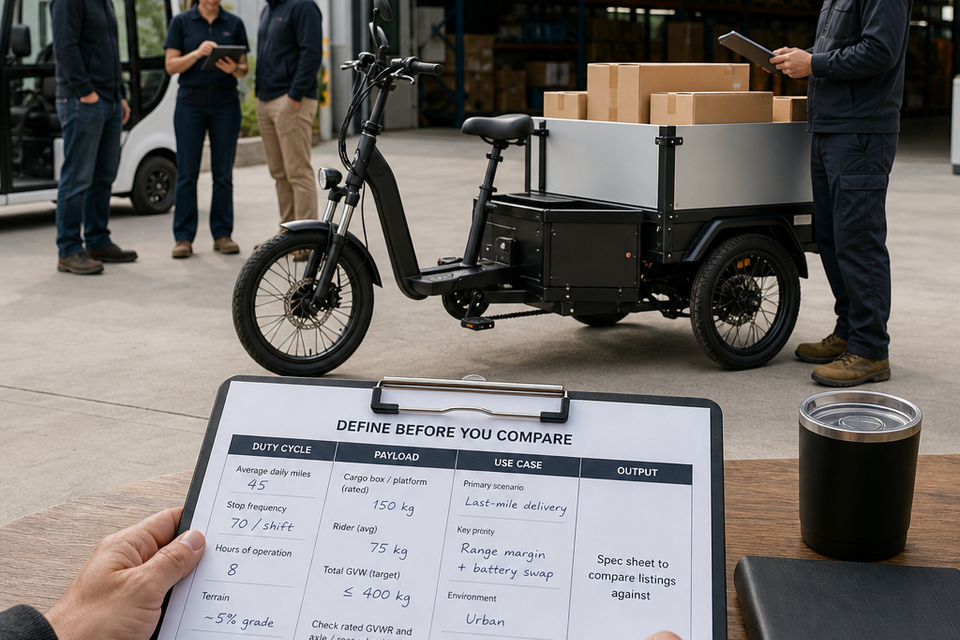
Before comparing electric three wheel bike listings, document your duty cycle, payload, and use case. Listings quote range and load capacity under different conditions, so a written spec sheet is the only reliable baseline for an apples-to-apples comparison.
The question to answer is not “which electric three-wheel bike is decent?” It is “which model holds up under my daily duty cycle, payload, and support needs across 10 or 50 units?” Write your requirements first, then use them as pass/fail criteria for every listing.
Step 1: Write a one-page requirements statement (about 1-2 hours)
- What: Record daily hours, daily distance, rider plus cargo weight, terrain, climate, and charging access.
- Why: A trike that suits a weekend rider can fail under a ten-hour delivery shift. Your requirements become the criteria for every later step.
- How: Pick your three most demanding conditions. For example: 60 km per day, 150 kg of cargo, on grades. Turn each one into a spreadsheet column.
Common mistakes to avoid
- Copying “up to” range figures as your requirement. Use your realistic worst-case day instead.
- Ignoring combined weight. A 90 kg rider with 150 kg of cargo puts 240 kg on the frame, not 150 kg.
Pro tip: Ask every supplier to state its duty-cycle assumption in writing: daily km, load, hours per day, and climate. Without a shared baseline, a “long-life battery” claim tells you nothing. Once answers use the same baseline, you can compare them side by side.
Columns to carry into the scoring sheet
- Rated payload (confirm it covers the cargo box, not only the frame)
- Cargo-box configuration
- Stated duty-cycle assumptions
- Battery cycle-life claims, in writing
- Parts availability
- Warranty claim process
Some buyers rank the highest payload rating first. However, check whether that rating comes with range figures measured under the same load. A high number without matching conditions can hide a shortfall on your route.
Expect to revise this sheet. Log two weeks of real usage data, if you can, and update the requirements before you request quotes.
Browse current models on our electric three wheel bike for sale page. When your requirements sheet is complete, send it to our team for a quote.
Step 2: Confirm Legal Classification and Certifications for Your Jurisdiction

Before you source or sell electric three-wheel bikes, confirm the vehicle category, power and speed limits, and required certifications for your jurisdiction. Units that fail any checkpoint need spec changes or legal review before purchase.
Decide the legal class before you compare prices. A trike can count as a bicycle, a low-speed vehicle (LSV), or a moped or motorcycle, depending on where it rides. That class controls where the trike can go, whether a license or registration applies, and which certificates you must hold.
Why it matters: Many listings skip this step. A “UL-listed” badge tells you nothing about whether your state treats the trike as a bicycle.
How to do it:
- Read the vehicle code. Search your state or national code for “low-speed vehicle” and “moped.” Note the speed caps and motor power limits.
- Check local rules. Bike lane, sidewalk, and trail rules often differ from state law.
- Build a jurisdiction sheet. Record the class, speed limit, helmet or license rule, and required certificates for each market.
- Request certificate numbers. Ask for a number for each standard that applies, then look it up in the certifying body’s online directory:UL 2849: e-bike electrical systems (North America)UL 2271: batteries in light electric vehiclesEN 15194: power-assisted cycles (EU)UN 38.3: lithium battery transport testing
Test claims, don’t trust banners. Eskute warns buyers about fake ESKUTE websites, which shows that brand claims need checking. Ask suppliers for:
- Dated production photos of your exact model
- Export records, such as commercial invoices and packing lists, for past shipments
- Certificate numbers that match the models on your order
Ask the factory who owns it, which lines build this model, and what in-house testing it runs. Then test samples before shipment: brakes, controller temperature under load, and charger labels and manuals.
This article does not set benchmark thresholds. Set your own pass criteria from your market rules or a third-party lab. Record every result in a shared comparison sheet so each supplier scores the same way.
Decision rule: Require a certificate number for every listed certification before you pay a deposit. A listing with no number counts as no certification. Add testing and certificate costs to your landed-cost model before you compare FOB prices.
Browse electric three wheel bike for sale options, then send your target markets and model list through our contact page to request certificate numbers before you shortlist.
Step 3: Verify Whether the Supplier Is a Manufacturer, Reseller, or Fake Storefront
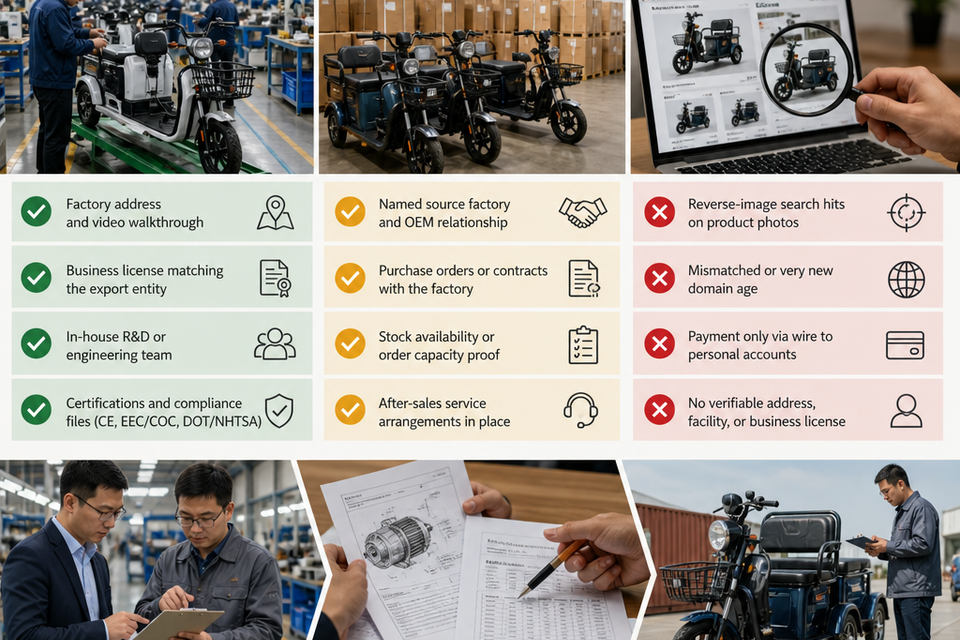
Before you compare prices on electric three wheel bikes for sale, confirm who you’re buying from. Manufacturers can usually show a factory, certifications, and engineering documentation; resellers should name their source; fake storefronts typically fail the reverse-image and payment checks. Verifying the supplier type first protects your margin, warranty path, and delivery timeline.
Confirm the factory claim before you compare prices. A real manufacturer can back it up with documents and specific answers. A reseller or fake storefront usually can’t.
Why it matters: Resellers add margin, and they often can’t answer engineering questions about the frame or controller. Fake storefronts can take deposits and disappear. Some competitors warn about fake sites for this reason.
How to do it:
- Request production evidence. Ask for timestamped production-line photos, a business registration number, and an export license or customs records.
- Match certificates to numbers. Check the certificate numbers against the listed standards, such as UL 2849 or EN 15194. Verify each one directly with the issuing body, not through a link the supplier sends.
- Ask factory questions. Who designs the frame and controller? Which welding and tooling run in-house? Which subcontractors make the batteries? What is monthly output? Can your inspector visit?
- Mark each item. Label every item as received, mismatched, or missing.
Common mistakes:
- Trusting a “verified manufacturer” badge without checking the registration number.
- Paying a full deposit before the certificate numbers clear.
Hypothetical scenario: A senior-care operator wants 10 trikes. Supplier A quotes [$X] per unit, and Supplier B quotes [$Y] per unit. Supplier A is cheaper, but it can’t name its battery subcontractor or provide battery transport paperwork. The operator also needs to confirm how each model is classified (bicycle, low-speed vehicle, or moped) and where local rules allow trikes to ride. Supplier A fails on paperwork before price matters. Confirm jurisdiction rules with local authorities or legal counsel.
Time and effort: Expect one to two days per supplier, mostly waiting on documents and certificate checks.
Start with the electric three wheel bike for sale catalog to compare models. Then send your document checklist through our contact page.
Step 4: Build a Landed-Cost Worksheet and Rank by Total Cost Per Deployed Unit

Rank suppliers on cost per deployed unit, not FOB price. Freight, duty, battery compliance, and transit loss can reorder a supplier list, and this worksheet structure makes those differences visible before you commit to an order.
Rank suppliers by landed cost per deployed unit, not FOB price. Once you add tier breaks, freight, duties, battery charges, and local compliance costs, the cheapest quote often ranks last.
Build one worksheet row per quote:
- FOB unit price at each MOQ tier
- MOQ and tier break quantities
- Packaging and crating per unit
- Freight per unit at your fleet size
- Import duties and fees
- Battery shipping surcharge
- Registration, insurance, or certification cost per unit
- Total divided by units = cost per deployed unit
Get every tier in writing. Check whether buying one unit below a break saves money or costs you more.
Hypothetical scenario (all figures are placeholders)
A senior-care operator plans a 10-trike fleet and has two quotes:
- Quote A: $[FOB-A] per unit, China-made, lowest FOB.
- Quote B: $[FOB-B] per unit, Mexico-assembled, higher FOB but lower freight [FREIGHT-B].
Before running the numbers, the operator checks three things:
- Classification: Quote A’s listed top speed may place it in the moped category, which can require registration and insurance at [$X per unit per year].
- Battery paperwork: Quote A’s supplier cannot provide a battery transport declaration. The carrier may refuse the shipment or add a surcharge of [$Y].
- Riding rules: Local paths may bar motorized trikes where residents walk.
Quote A drops out before price decides anything. Quote B stays in, pending the same checks.
Some buyers argue that compliance checks slow procurement. However, a two-week review costs less than a fleet that sits in a depot because it cannot legally ride.
Mistakes to avoid
- Ranking on FOB alone.
- Ignoring crating and battery surcharges.
- Skipping certification evidence. Ask for test reports to UL 2849 or EN 15194 where they apply.
Time and effort: Expect two to three days to build the worksheet for two or three quotes, plus the time to get written answers from suppliers.
Confirm classification, battery transport, and riding rules with your local authority or legal counsel. Rules vary by jurisdiction and change.
Next, compare comparable models in the electric three wheel bike for sale catalog, then request a landed-cost quote with your fleet size and destination.
Step 5: Score Fleet Durability Across Payload, Cargo Box, Duty Cycle, and Battery Cycle Life
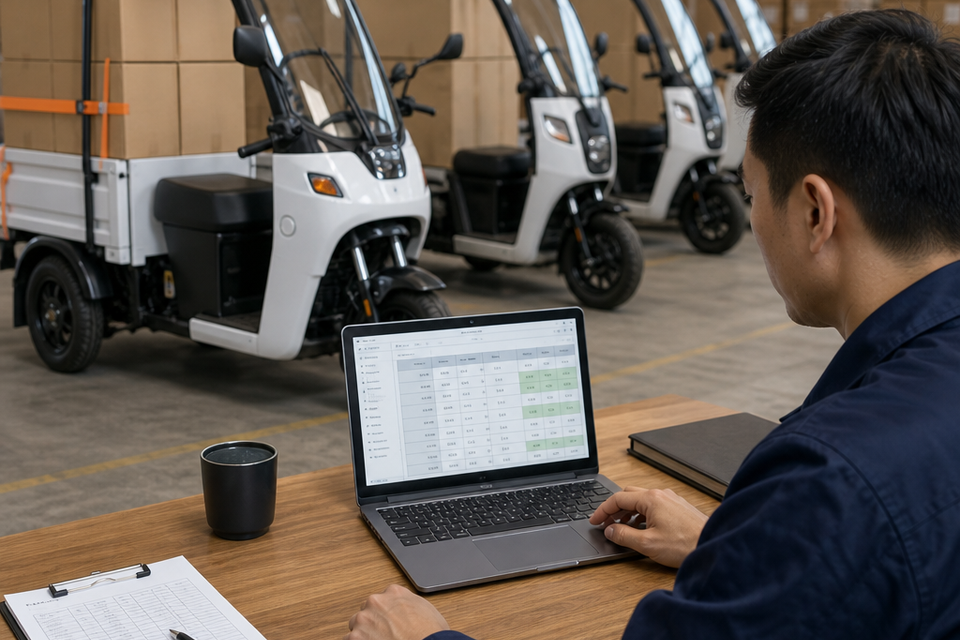
Score each durability factor separately, then weight them to reach one fleet-level number. Payload and battery cycle life usually carry the most weight for commercial operators, because they drive both downtime and total cost of ownership. Use the same duty-cycle assumptions across all supplier quotes so the scores can be compared directly.
Score each model from 1 to 5 on four durability variables: rated payload, cargo box, duty cycle, and battery cycle life. Score only what the supplier confirms in writing.
Why it matters: A rated payload badge does not show whether the frame and brakes hold up after months of daily use. Fleet wear builds up over hours, not single loads.
How to score each variable:
- Rated payload: Ask for the test standard and whether the rating is static or dynamic. A static figure and a dynamic figure do not compare directly.
- Cargo box: Request dimensions, mounting method, and weather sealing. A box with no sealing spec scores lower.
- Duty cycle: Ask for the hours per day and load the durability claim assumes. Compare those numbers to your actual routes.
- Battery cycle life: Require the cycle count, the capacity retention level, and the test temperature. A cycle count alone tells you little.
Illustrative scenario (hypothetical): A senior-care operator receives two quotes for a six-trike fleet. Quote A is [PLACEHOLDER: lower price]. Quote B is [PLACEHOLDER: higher price]. Before scoring durability, the operator checks three things:
- Classification: Quote A’s trike may fall into a different class (bicycle, low-speed vehicle, or moped) than the operator assumed, with different licensing rules.
- Battery transport paperwork: Quote A’s supplier cannot provide shipping documentation [PLACEHOLDER: confirm].
- Riding access: Local rules may bar Quote A’s class from the paths residents use.
Quote A drops out before price matters. Confirm all rules with local authorities or counsel.
Common mistakes:
- Accepting a cycle count with no retention level or test temperature.
- Comparing payload ratings that use different test methods.
Pro tip: Ask each supplier for a fleet reference customer. Call them about daily hours and failure history.
Time estimate: Plan 2 to 3 hours per supplier for written questions and scoring.
Compare comparable models in the product catalog, then send your written questions through the contact page.
Step 6: Test Samples Against Your Own Pass Criteria and Record Results
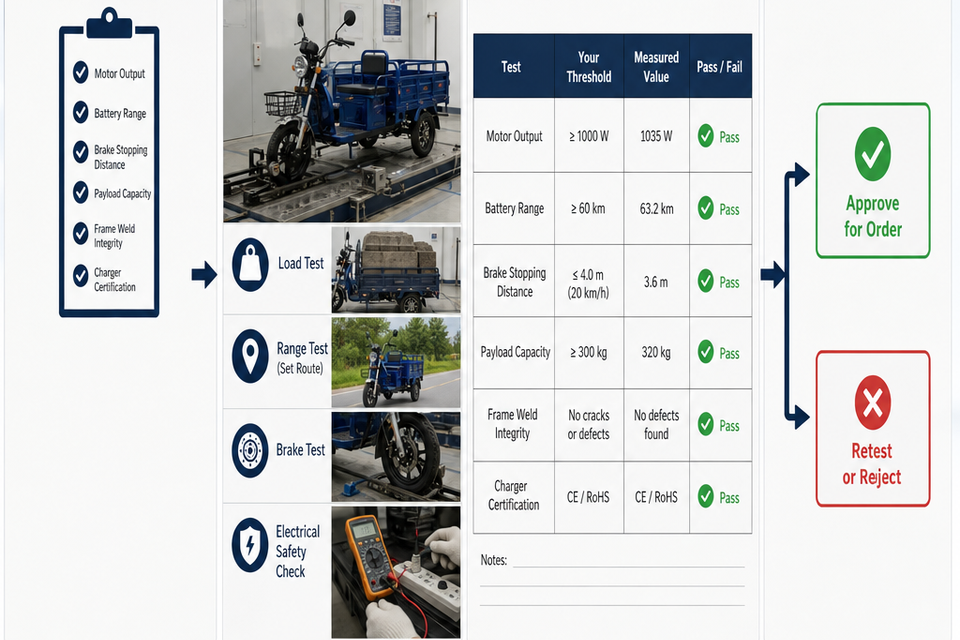
Define your pass criteria before samples arrive, then log every measured result against them. A written scorecard with clear thresholds turns supplier samples into a documented, defensible purchasing decision.
Step 6 means testing one sample against pass criteria you wrote before the test. Your own requirements, or a certified lab’s test plan, decide what counts as a pass. This guide does not set benchmark numbers.
Estimated effort: [X] days to get a sample shipped, plus about [X] hours of testing per unit.
1. Request a production-batch unit.
- What: Ask for one unit from the batch you would order.
- Why: A showroom model or a unit the supplier prepared for review may not match what ships.
- How: Put this in writing when you request the sample.
2. Run the brake test.
- What: Make repeated stops from a fixed speed on a trike loaded to your expected payload.
- Why: One good stop proves little. Repeated stops show fade.
- How: Log stopping distance for every stop and note any change from the first stop to the last.
3. Log controller heat.
- What: Run a continuous load and record surface temperature at fixed intervals.
- How: Log readings every [X] minutes for the full run, with the ambient temperature.
4. Check charger documentation.
- What: Compare the charger’s certification label, input rating, and output against the battery spec.
- Why: A certified battery does not certify the charger. Skipping this check is a common gap.
5. Record every result. Use one shared sheet with these columns:
| Test | Pass criterion | Result | Date / serial / tester | Evidence file |
|---|---|---|---|---|
| Brake, repeated stops | [your criterion] | [result] | [date / serial / name] | [file link] |
Scenario (hypothetical): A senior-care operator gets two quotes for a 12-unit fleet: Quote A at [$X] per unit and Quote B at [$Y]. Before comparing price, the operator checks three things:
- Classification: Quote A’s trike appears to fall outside the bicycle category based on its motor output and top speed. In the operator’s state, that could change where units may ride. Confirm with local authorities or counsel.
- Battery transport: Quote A’s supplier cannot provide battery shipping documents.
- Riding rules: Local rules may limit where the trikes can operate.
Quote A drops out before price matters.
Pro tip: Send your pass criteria to the supplier before the sample ships. That makes the results hard to argue with later.
Next step: Compare comparable models in the product catalog. Then contact us with your test criteria and fleet size.
Step 7: Evaluate Parts Availability, Service Coverage, and the Warranty Claim Process
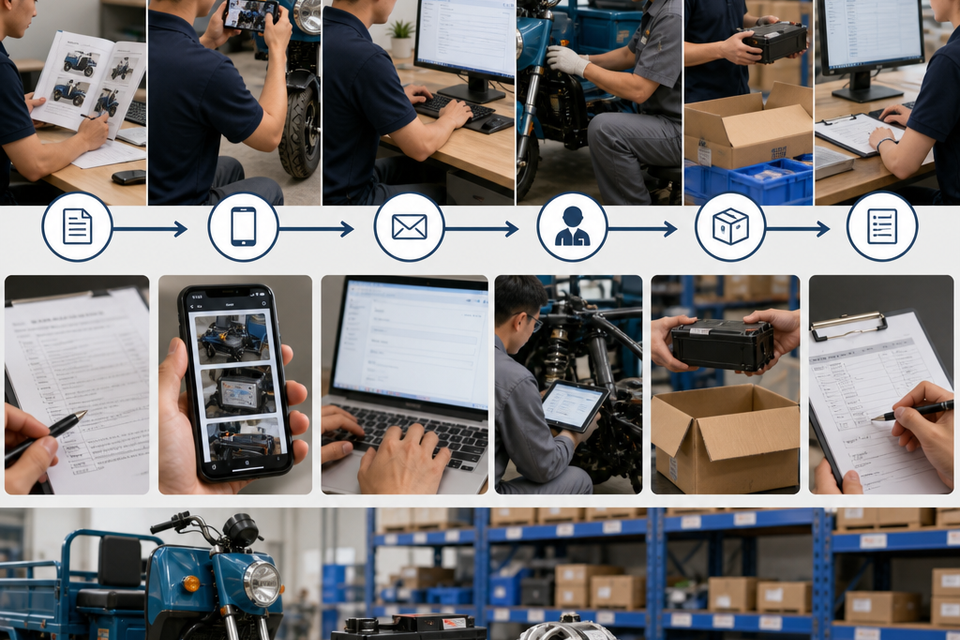
The warranty claim process runs on documentation and parts access. Verify service coverage and parts lead times before you sign, because the claim is only as fast as the supplier’s stocked inventory and the evidence you can provide.
Before you sign, confirm who fixes your trikes, how fast parts arrive, and how a warranty claim moves from start to finish. A “lifetime warranty” means little if no one stocks brake pads near you.
What to do: Ask the supplier how it supports 10 or 50 units after delivery. Request a parts list with stock locations and typical replacement lead times for brakes, controllers, batteries, and tires.
Why it matters: A fleet cannot absorb downtime the way one consumer rider can. Every idle trike means a missed route and a rider who needs another ride.
How to do it:
- Ask for a parts table with a column for your nearest stocking location:
| Part | Lead time (days) | Nearest stock |
|---|---|---|
| Brake pads | [X] | [City] |
| Controller | [X] | [City] |
| Battery | [X] | [City] |
| Tires | [X] | [City] |
- Get the warranty claim steps in writing, from submission to resolution. Ask who pays return freight and how long each stage takes.
- Ask who services units in your region and what they charge per hour: [X] (placeholder).
Hypothetical scenario: A senior-care operator compares two quotes for a 10-trike fleet. Quote A is [X] per unit cheaper. Before comparing price, the operator checks classification (bicycle, low-speed vehicle, or moped), battery transport paperwork, and local rules on where trikes may ride. Quote A’s model falls into a class that the city does not allow on paths the fleet needs. The cheaper quote drops out before price decides anything. Confirm rules with local authorities or counsel, because this is not legal advice.
Pro tip: Negotiate a spares kit into the initial order. Price it into your landed cost from Step 4 so you pay for it once, up front.
Common mistakes:
- Trusting “lifetime warranty” wording without the claim process.
- Assuming parts ship from the factory with no regional stock.
Time required: About 1 to 2 hours to build the parts table and send the questions.
Next, browse comparable models in the electric three wheel bike for sale catalog. Then contact us to request parts lead times and regional service details.
Common Evaluation Mistakes Buyers Make When Comparing Trike Listings
Most buyers compare trike listings on sticker price first. Check total landed cost and compliance status before you rank anything.
Mistake 1: Chasing the lowest FOB price. Freight, import duties, and battery shipping surcharges often sit outside the quoted price. Ask each supplier for a landed-cost quote per unit at your order quantity.
Mistake 2: Accepting “UL” or “CE” labels without numbers. Ask for the certificate number and issuing lab, then verify it yourself. Without a number, you have nothing to show a registration office or insurer.
Mistake 3: Treating single-owner reviews as fleet evidence. A personal rider rarely logs commercial daily hours. Ask for fleet references and battery service history instead.
Hypothetical example: A senior-care operator compares two quotes for a six-trike fleet. Quote A is [placeholder: lower price]. Quote B is [placeholder: higher price]. Before comparing prices, the operator checks:
- Classification: Is the trike a bicycle, low-speed vehicle, or moped locally?
- Battery transport paperwork: Does the supplier provide shipping documents?
- Riding rules: Where can the trikes legally operate on resident routes?
Quote A fails the classification check, so it drops out before price matters. Confirm local rules with your local authority or counsel.
Next step: Compare comparable models in our electric three wheel bike for sale catalog, then contact our team for a landed-cost quote and certificate numbers.
Counter-Arguments and Limitations of This Evaluation Framework
The framework has blind spots, and a cheaper quote can still cost more. Check compliance before you compare prices.
Hypothetical scenario: A senior-care operator compares two quotes for a six-trike fleet. Quote A is [$X,XXX placeholder] per unit, and Quote B is [$X,XXX placeholder]. Quote A’s listing calls the trike a bicycle, but its motor output and top speed may place it in the low-speed vehicle or moped class in the operator’s state. Its battery shipping paperwork is also missing. Quote A drops out before price matters.
Work through these checks in order:
- Classification: Confirm the vehicle class with your state motor vehicle agency or counsel.
- Battery transport: Request shipping documentation from each supplier.
- Riding rules: Ask local authorities where trikes may ride on your routes.
Re-verify classification and duty rates before every order, since regulations change. Audits also don’t guarantee future production runs, so schedule periodic re-inspection. Third-party testing costs time and money, so a small order may need a lighter protocol. Nearshoring from Mexico isn’t automatically cheaper; freight lanes, USMCA eligibility, and order volume decide that.
Browse comparable models in our product catalog, then contact us once compliance checks pass.
Troubleshooting a Shortlist That Stalls or Produces Conflicting Quotes
When quotes conflict, stop comparing prices. First confirm that every quote covers the same product, terms, and legal category.
- MOQ tier: Confirm the order quantity behind each price. Lower unit prices may require higher minimums.
- Incoterms: FOB excludes freight and duty. DDP includes them. Convert both to landed cost.
- Battery surcharges: Ask whether lithium shipping fees sit inside the price.
- Certificate numbers: A supplier who refuses to share them is a red flag. Move to the next candidate.
Hypothetical: A senior-care operator gets two quotes for a six-trike fleet: [PLACEHOLDER: lower price] and [PLACEHOLDER: higher price]. The operator asks a broker to classify each model as a bicycle, low-speed vehicle, or moped. The cheaper trike falls into the moped class, which local rules bar from the paths the fleet needs. That option drops out before price matters. Confirm your local rules with authorities or counsel.
If a sample differs from its listing, photograph it, log serial numbers, and request a written explanation and a same-batch replacement.
Browse comparable models or send your spec sheet to start a clean comparison.
Frequently Asked Questions About Buying Electric Three-Wheel Bikes in Bulk
A three-wheel e-bike counts as a bicycle only where local law says so, and that depends on jurisdiction and motor power. Confirm the classification before you compare quotes.
Is a three-wheel e-bike legally a bicycle? Not automatically. Some regions treat it as a bicycle, while others classify it as a low-speed vehicle or moped. Each class brings different licensing, helmet, and path rules. Ask your local authority or counsel to confirm in writing.
Which certifications should I request first? Ask each supplier for the electrical system and battery standards that apply to your destination, with certificate numbers. Common references include UL 2849 and EN 15194. Check the numbers with the issuing body. Do not rely on a PDF alone.
Does a lower MOQ mean a lower landed cost? No. Compare per-unit landed cost within the same order tier. Include freight, import duties, and battery shipping surcharges. A low MOQ often carries a higher unit price.
How long should a sample test take? Plan for one to two weeks, including shipping and testing.
Can I verify a supplier without visiting? Yes. Request business registration, a factory video walkthrough, and a third-party inspection report before you pay a deposit.
Hypothetical scenario
A senior-care operator wants a 10-trike fleet and receives two quotes. Use these placeholder figures:
- Quote A: $[unit price A] per unit, lowest headline price
- Quote B: $[unit price B] per unit, higher headline price
Before comparing prices, the operator checks three things:
- Classification: Quote A’s model falls under moped rules in the operator’s area. Staff would need licensing they do not hold.
- Battery transport: Quote A includes no battery shipping documentation, which adds a delay and a surcharge of $[surcharge].
- Riding rules: Local rules restrict motorized vehicles on the paths residents use.
Quote A drops out before price matters. Quote B wins, even at the higher unit price.
Next steps
- Build a worksheet with landed cost per tier, certificates, and classification notes.
- Browse comparable models to set your baseline.
- Once documents check out, request a formal quote.
Post time: 11-24-2026