

If you’re searching for a cheap electric trike, the real worry usually isn’t the price tag. It’s ending up with a unit that’s illegal for where you ride, or one that stalls out for weeks when a controller or battery fails. The short answer: you can get a low-cost trike without giving up safety or parts support, but only if you check legal class, total landed cost, and service evidence before you compare sale prices. This guide walks through that process in order: setting up your worksheet, confirming legal class, building a three-tier total-cost comparison, auditing warranties and parts availability, verifying country of assembly and discounts, and running a pre-purchase risk screen. You’ll finish with a shortlist you can defend and a set of written questions to send vendors.
Prerequisites: What You Need Before Comparing Cheap Electric Trikes
Short answer: Before you compare cheap electric trikes, set a total landed-cost ceiling, define your use case, and collect quotes you can verify. A low sticker price tells you little about what the trike costs over its first year.
1. Build a total-cost worksheet. Create a spreadsheet with one column for each of three price tiers under $1,500. Treat every input as an assumption until you source it:
- Battery replacement cost, by amp-hour rating
- Tire and brake wear items
- Shipping and import duties
- Local registration and insurance
Paste in real quotes from autotrikes.com/products/ or other sellers. Log each quote with its date and source.
2. Set a landed-cost ceiling. Reserve about 10-15% of your budget for shipping, duty, and first-year wear. This range is a starting assumption. Replace it with your own quotes.
3. Define the use case, then check the rules. Commuting, recreation, and mobility support each point to different legal classes and component specs. Check official sources such as gov.uk, your EU member-state transport site, or your US state DMV and federal e-bike definitions. Wattage and top speed decide whether a trike counts as a bicycle or a moped.
4. Audit the warranty before you pay. Read the warranty document, not the sales page. Confirm what the 1-year or 2-year term covers and who ships replacement parts. Rushing this step is the most common reason buyers end up with units they cannot service.
Time: Plan 3-5 hours across one week.
Common mistake: Comparing sale prices alone. A cheap trike with costly batteries or high shipping can cost more than a higher-priced model.
Step 1: Define Your Use Case and Confirm the Legal Classification
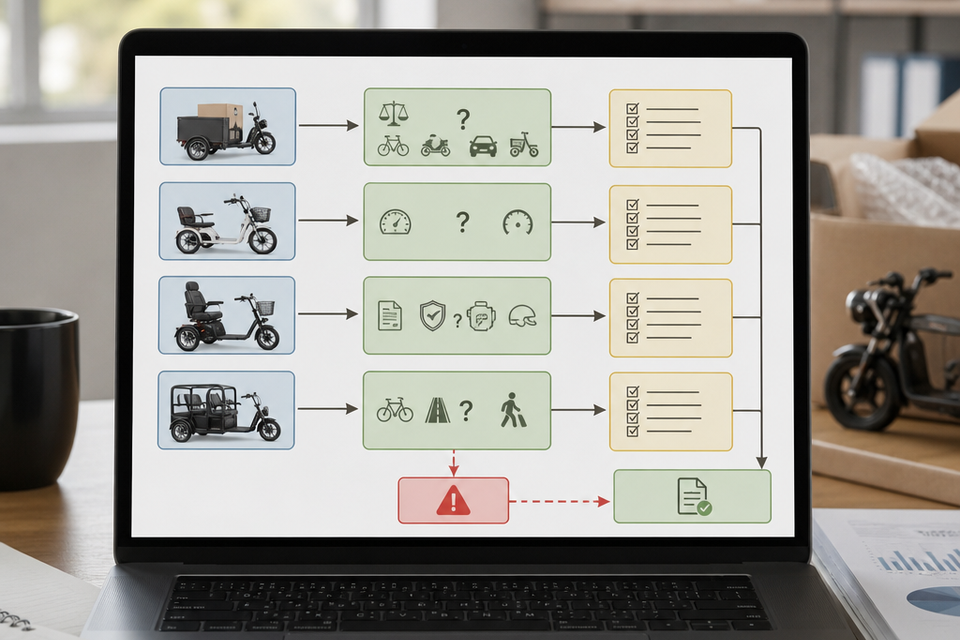
Classify the vehicle before you compare prices. A low-cost trike that falls outside your jurisdiction’s limits for power, speed, or vehicle category can require costly modifications, registration, or be prohibited from your intended routes. Confirm these rules first, then use them as your filter for supplier quotes.
The legal class decides whether you need registration, insurance, a licence, or helmet rules. Settle your riding context and top speed first, then check the listing against official thresholds. Many buyers learn after purchase that a fast, cheap trike counts as a moped.
Step 1: Pick your riding context. Choose one: private land, bike lane, shared path, or public road. Write down your target top speed. Each context carries different limits, so a trike that works on a bike lane may not be legal on a public road.
Step 2: Check the three specs against official sources. Look at the motor rating, the assist cutoff speed, and whether the throttle works without pedalling. Compare these against government sources, not vendor summaries.
| Region | Threshold to check | Where to verify |
|---|---|---|
| UK | EAPC: 250W continuous rated motor, assistance cuts out at 15.5 mph | gov.uk |
| US (federal) | Low-speed e-bike Classes 1-3; Class 3 assist ceiling is 28 mph | Federal definitions; state rules can differ |
| EU | Commonly 250W and 25 km/h, varies by member state | Your national transport authority |
The 500W figure repeated online is not the UK EAPC line. A listing that exceeds these limits, or uses a throttle that runs without pedalling, may fall under motor vehicle rules.
Step 3: Get the controller speed in writing. Ask the vendor for the controller’s maximum assist speed and the motor rating. Save the reply in your notes file. A written answer gives you proof if the unit’s performance does not match the listing.
Common mistakes:
- Trusting “street legal” marketing copy without checking the official threshold.
- Assuming pedals mean the trike is classed like a bicycle.
- Applying one country’s rules to a shipment going to another.
Time required: About 30 to 45 minutes. Pro tip: Do the warranty and parts check in the same session. Ask for warranty terms and parts lead times in writing, and confirm service support through the contact page before you pay.
Step 2: Build a Total-Cost-of-Ownership Worksheet Across Three Price Tiers
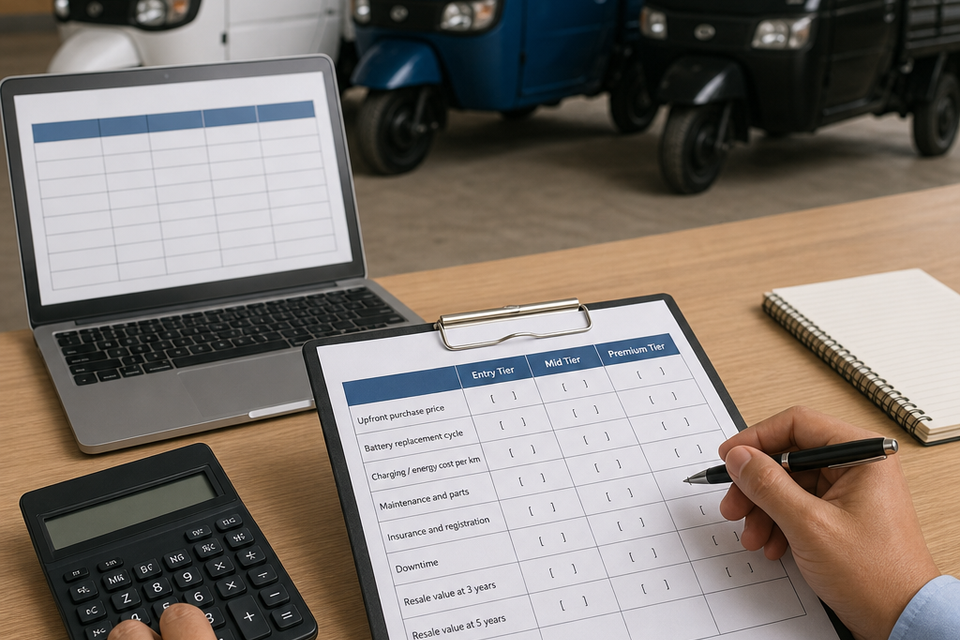
Compare tiers on the same cost rows, not on sticker price alone. A lower-priced trike can cost more per delivery once battery replacement, downtime, and resale value are included.
Build one worksheet that compares three price tiers under $1,500 on landed cost plus two years of running cost. A low sticker price often loses once you add duty, registration, and the first battery or brake replacement. Treat every cell as an assumption until a dated quote replaces it.
Before you fill in numbers, check whether each tier can be repaired at all. A cheap trike with a failed controller and no local parts supplier can leave you without a usable vehicle for weeks. So the worksheet covers two things: cost and failure exposure.
1. Set up three tier columns
Pick a low, mid, and near-ceiling model. Add a status column for each row, marked “Assumption” or “Verified,” with the source and date.
2. Enter landed cost
- Sale price
- Shipping, import duty, and local taxes
- Registration and insurance
Why: Sticker price leaves out everything after checkout. Duty depends on origin and import rules, so get the figure in writing for each shipment. Last year’s number is not a valid input.
3. Add 24-month wear items
Enter expected costs for the battery, tires, brake pads, and one electrical repair. Get at least two quotes for each item from a parts retailer or battery supplier.
4. Run the legal and parts screen
Check your region’s wattage and top-speed limits on the official government site. The UK figures in this brief, 500W and 28 mph, are examples to confirm on gov.uk before you buy. A trike above those lines may need registration or fall under moped rules.
Then answer three questions for each tier:
- Are replacement parts stocked in your country?
- Where is the unit assembled?
- Does the warranty cover the battery, and for how long?
A tier that fails any of these checks is a risk, even if its total looks low.
5. Compare totals
Use this rule: if the cheap tier’s 24-month total, including the replacement you expect, exceeds the mid tier’s total, the cheap trike is not the better deal.
Common mistakes to avoid
- Comparing battery price alone. Check amp-hour rating and chemistry. A pack that differs from the original may not fit your charger or match your range.
- Ignoring duty on cross-border shipments. Duty can change the ranking of your tiers.
- Treating one quote as market price. One vendor’s number tells you about one vendor.
Pro tip: Ask every vendor for battery voltage, Ah rating, cell type, and charger rating. Replacement quotes then match the original pack.
Time required: About three to four hours for a first pass, plus several days while you wait for quotes.
Reddit buyers asking for a “good budget e trike” often worry about getting stranded with a cheap unit and no service nearby. Your worksheet should answer that worry before you buy. You can compare current models or contact our team to request battery specifications for your worksheet.
Step 3: Audit Warranty Terms and Real Parts-Support Evidence

Before you commit to a low-cost electric trike order, verify the warranty in writing, confirm coverage for each major component, and check that wear parts are stocked locally. A low sticker price often hides long parts lead times or a battery warranty shorter than the frame warranty.
Short answer: Pull the written warranty for every shortlisted brand. Record the length, covered components, exclusions, stated parts lead time, and whether parts are stocked in your country. If a vendor does not publish a field, mark it “not disclosed” and do not fill it in from assumption.
Why it matters
A one-year and a two-year warranty can cover very different parts. Warranty length matters less than what the warranty covers. Lead time matters because it decides whether a failure costs you a week or several months of riding.
How to do it (about 2 to 3 hours for four to five brands)
- Save the written text. Copy the warranty page or PDF with the date and URL. Verbal promises from sales staff don’t count.
- Build the matrix. Use the columns below.
- Read the exclusions first. Budget warranties often exclude batteries and wear items like tires and brake pads.
- Confirm stock location. Ask where replacement parts ship from.
Start the matrix with a methodology note: date checked, source URL, who verified it, and whether the vendor sent a written reply.
| Field | What to record |
|---|---|
| Warranty length | Months or years, and the start date |
| Covered components | Frame, motor, controller, battery, tires, brakes |
| Exclusions | Battery, wear parts, shipping, labor |
| Stated parts lead time | Days from order to delivery, as written |
| Parts stocked locally | Yes, no, or not disclosed |
Illustrative scenario (fictional numbers)
Dana, a fictional commuter, compares a $1,200 kit with a $1,450 assembled unit. Her illustrative estimates:
- Kit: $1,200 plus $180 for brakes, lock, and fenders. The warranty excludes the battery.
- Assembled: $1,450 plus $60 for accessories. The warranty covers the battery for two years.
- Battery failure in month 20 (illustrative): A replacement costs $220 out of pocket on the kit. That makes the kit $1,600 total, versus $1,510 for the assembled unit.
The $310 sticker gap is gone after one battery swap. Dana should replace the illustrative numbers with quotes, her region’s registration and insurance fees, and the lead time the vendor confirms in writing.
Common mistakes to avoid
- Accepting “lifetime support” with no written definition.
- Assuming a US warranty covers UK or EU shipments.
- Skipping battery exclusions, which are common in budget warranties.
Pro tip: Send each vendor one written question, such as “What is the lead time for a controller replacement shipped to [your country]?” Log the date, whether they replied, and what they said. A vendor that does not answer has also given you useful data.
Step 4: Verify Country of Assembly and Manufacturing Transparency
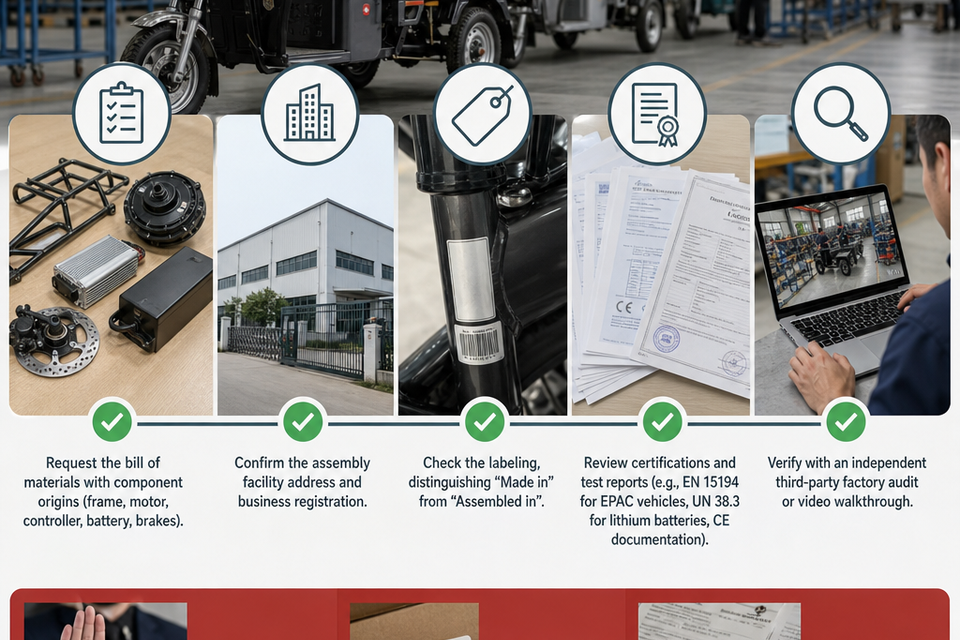
Cheap electric trikes often list only a general “Made in” country. Work through each checkpoint to confirm where the frame, drivetrain, and battery were produced and where final assembly took place. Buyers who skip this step risk certification gaps and warranty disputes.
Short answer: Ask each shortlisted seller where the trike is assembled, where the frame and motor come from, and to put both answers in writing. If a seller won’t, treat the origin as unknown.
Why it matters: Assembly location affects lead time, duty treatment, and how quickly a warranty claim gets answered. Buyers keep asking about specific origins on Quora, yet many product pages skip this detail.
Illustrative scenario: Maya is a fictional commuter. These numbers are invented for this example. She compares a $1,200 kit with a $1,450 assembled unit. The kit seller describes the trike as “designed in” one country but won’t name the assembly site. The assembled-unit seller names the site and the motor supplier.
Maya estimates the kit needs $180 in accessories and one $120 service visit, for a total of $1,500. The assembled unit needs $60 in accessories and no early service visit, for $1,510. The sticker gap nearly disappears once she adds likely costs. The deciding factor becomes whether she can confirm who fixes the trike and how fast parts arrive.
Replace these with your own values: seller quotes, your local registration fee, and the duty rate that applies to your shipment.
How to do it:
- Request a written statement covering final assembly location, frame origin, motor origin, and controller and battery supplier.
- Cross-check against shipping documents or customs data if the seller provides them.
- Confirm duty per shipment. Do not assume it from the country of origin.
| Assembly country | Component origin | Disclosed? |
|---|---|---|
| Stated in writing | Frame and motor named | Yes |
| “Designed in” only | Not stated | No |
Common mistakes:
- Equating “designed in” with “made in.”
- Assuming a particular origin guarantees quality. Some might argue that origin signals reliability. However, assembly quality depends on the factory and its inspection process.
- Relying on a single forum post.
Pro tip: Ask whether the controller and battery come from the same supplier as the frame. Mixed sourcing often makes replacement parts harder to match and slower to get.
Step 5: Verify Discounts Against Price History Before You Buy
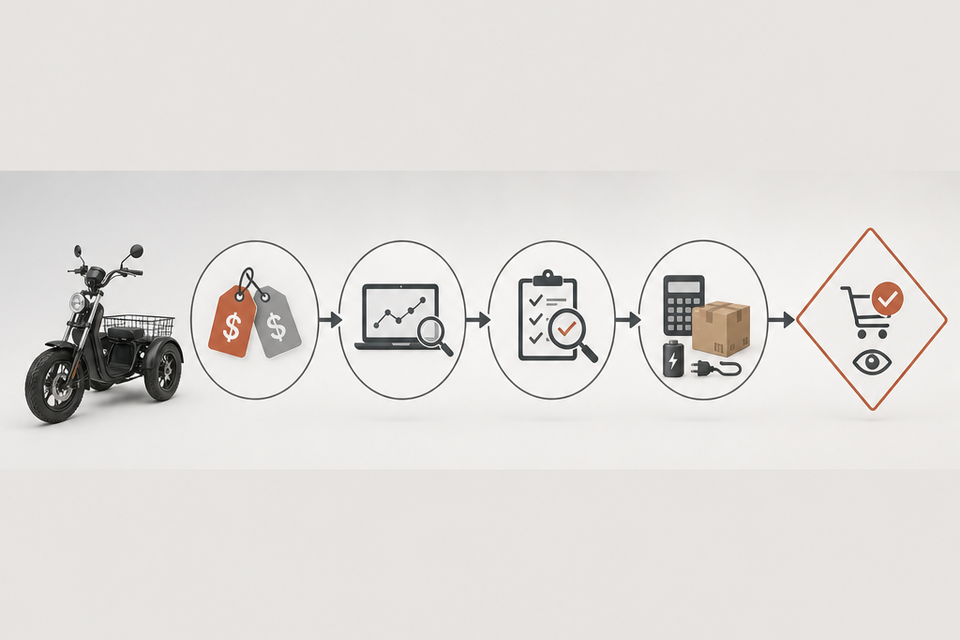
Before you buy, confirm the discount is real. A “was” price only matters if the item actually sold at that level recently, and the true cost includes shipping and accessories.
A discount only counts if the sale price beats the product’s recent market price. Before you buy, check the price history for several weeks and compare the manufacturer’s site with marketplace offers.
Discount banners often cite an “original price” the trike rarely sold at. If you trust that label, you can pay more than the normal street price during a promotion.
How to verify a sale (about 30 to 45 minutes):
- Use a price tracker where one exists. If none exists, record the listed price yourself.
- Log at least three dates over several weeks. Calculate the median. Compare the sale price to that median, not the “was” price.
- Note bundled accessories. A kit with a charger, lock, or lights is not the same product as a bare unit.
- Compare the manufacturer-direct price with marketplace listings. Check who backs the warranty. Marketplace sellers may not honor the manufacturer’s terms.
- For refurbished or open-box units, ask two questions. Is the battery original or replaced? Does the warranty run from the original sale date?
Illustrative scenario (fictional buyer, invented numbers): Maya, a commuter, compares a $1,200 kit she assembles herself with a $1,450 assembled unit. Her tracker shows the kit’s 60-day median at $1,300 and the assembled unit’s at $1,400.
- Kit: $1,200 plus $90 for accessories plus $150 for a shop assembly check = $1,440
- Assembled: $1,450 with accessories included and manufacturer warranty = $1,450
The kit saves $10 at checkout, but the gap is small. If Maya would pay a shop to fix a loose brake or wiring issue in year one, the assembled unit becomes the better buy.
Substitute your own values: your tracker’s medians, real accessory quotes, local shop rates, and registration fees for your region. Check your local wattage and speed rules before you compare prices.
Common mistakes:
- Trusting “was” prices.
- Buying refurbished without checking the refurbisher’s warranty.
- Ignoring restocking delays after seasonal sales.
Step 6: Run the Pre-Purchase Risk Screen
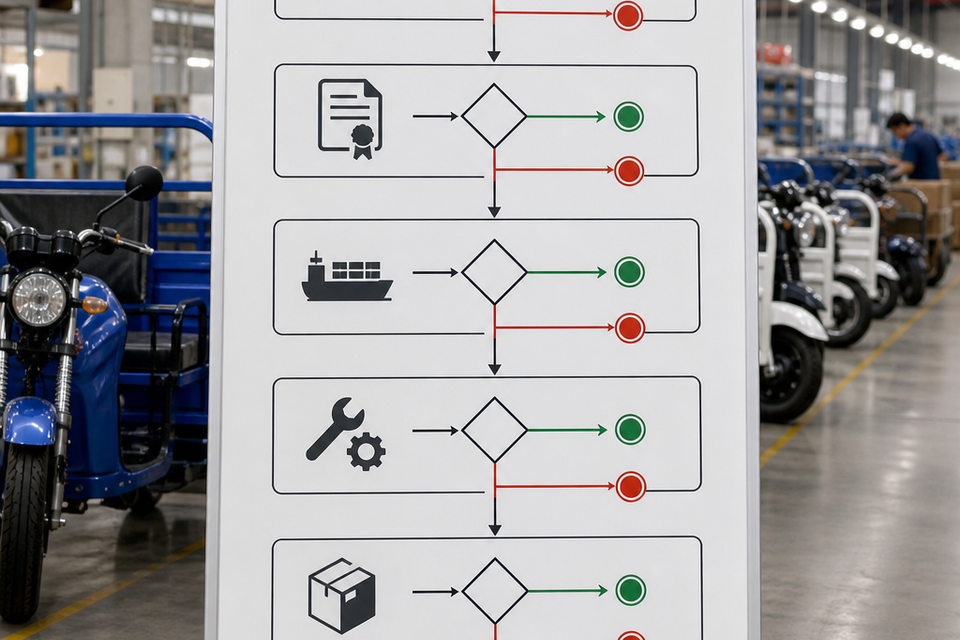
Run every gate before negotiating price. A low FOB quote can hide compliance gaps, freight costs, and parts problems that erase the savings. A “Hold” at any gate means pausing to resolve the issue, not walking away from the deal.
The fastest way to avoid an expensive mistake is to run one pass/fail screen before comparing prices. Any trike that fails a hard gate is out, however low its sticker price. Only the passing options move on to a landed-cost comparison.
The three hard gates
- Legal for your intended use. Check the trike’s rated power and top speed against your national or regional thresholds for road, bike lane, or path use. Use the regulator’s published figures, not the seller’s summary.
- A verified parts source. Name at least one supplier you can reach in your country, with a stated lead time in days. “Parts available on request” fails this gate.
- Assembly and warranty in writing. Get the assembly location (factory, dealer, or you) and the warranty terms (what it covers and for how long) in a written reply.
Why it matters
This screen changes the question from “which is cheapest?” to “which budget options fail before I spend money?” Price comparisons hide the costly failures: a trike you cannot register, or one that sits idle while you wait for a part.
Illustrative example (fictional persona and numbers)
Maya is a fictional commuter choosing between a $1,200 kit and a $1,450 assembled unit. All figures below are placeholders. Replace them with your own quotes.
- Gate 1: Maya checks her regional thresholds. Both models pass on paper, so she confirms the rated power in writing.
- Gate 2: The kit seller says parts are “available on request” and names no supplier. It fails. The assembled unit names a distributor and gives a lead time, so it passes.
- Landed cost (assembled unit): $1,450 price, plus an assumed $80 service visit in year one, gives $1,530. Substitute your own sourced service rate.
The kit looks $20 cheaper before accessories and service. Maya still rejects it, because a failed gate beats any price advantage.
Common mistakes
- Scoring legality as a soft preference.
- Letting a low price offset a failed gate.
- Treating “parts on request” as parts in stock.
Pro tip: If a trike passes all three gates but publishes no parts list, put it on a “conditional” list. Do not buy until the seller provides a written parts lead time.
Time required: About 2 to 3 hours to screen a shortlist of three to five trikes, plus a few days for written replies.
Step 7: Shortlist Vendors and Ask the Service Questions That Matter

Price is only one input when sourcing cheap electric trikes at fleet scale. Before you commit, get written answers on warranty coverage, battery replacement costs, parts lead times, and regional service support, because these determine total cost of ownership long after the purchase order is signed.
The short answer: shortlist two or three vendors and send each the same written questions. Written replies are the best evidence you can get about a vendor’s service network, especially when published information is thin.
Send these questions in writing:
- What is your warranty claim process, and who approves it?
- How many days will common wear parts take to reach my country?
- Who handles repairs: you, a local partner, or me?
- What does a replacement battery cost for this exact pack?
- Who pays import duty, and is it in the quote?
Log each reply with the date. A missing answer is also a signal.
Illustrative scenario (fictional commuter, numbers are placeholders): Maya compares a $1,200 kit with a $1,450 assembled unit. The kit looks $250 cheaper, but she fills in her own sheet:
- Accessories she expects to buy: [your quote]
- One plausible service visit: [local technician quote]
- Registration and insurance: [your regional rules and quotes]
Her parts-lead-time reply decides it. A vendor who gives a specific figure beats one who says “fast shipping.”
Common mistakes:
- Asking only about price
- Accepting verbal promises
- Ignoring vendors who never reply
Start your comparison at autotrikes.com/contact-us/ and send the same five questions to every vendor.
Real-World Cheap
A cheap trike is a good deal only if the total first-year cost stays low and the trike is legal where you ride. The sticker price is often the smallest part of that math.
Illustrative example: Consider a fictional commuter, Dana, choosing between a $1,200 kit she assembles herself and a $1,450 assembled unit. Every number below is illustrative. Replace each one with your own sourced quote.
Step 1: Calculate the landed price.
- What: Add shipping, import duties, and taxes to the listed price.
- Why: Freight and duties can erase a $250 gap quickly.
- How: Request a written, all-in quote. Dana’s kit lands at $1,320 (illustrative). The assembled unit includes delivery at $1,450 (illustrative).
Step 2: Add the accessories you need.
- What: List helmet, lock, lights, rack, and any parts the unit omits.
- Why: Kits often leave out lights and mounting hardware.
- How: Dana’s kit needs $180 in accessories, and the assembled unit needs $60 (both illustrative). Her totals become $1,500 and $1,510.
Step 3: Price the first service visit.
- What: Estimate what a shop charges to fix wiring, set brakes, or tighten fittings.
- Why: Kits often need more setup, and a stranded trike costs more than a repair.
- How: Dana’s kit needs a $120 shop visit (illustrative). Confirm whether the assembled seller includes a pre-delivery check. Her year-one totals become $1,620 for the kit and $1,510 for the assembled unit.
Step 4: Check registration and road rules.
- What: Find your region’s limits for motor power, top speed, registration, insurance, and licensing.
- Why: A high-speed unit may fall into moped rules even when the kit costs less.
- How: Read the motor wattage and top speed on the spec sheet. Then check your national transport agency’s rules for that class. Dana’s kit lists 1,000W and 28 mph, so she confirms her region’s rules before she buys.
Common mistakes to avoid:
- Comparing sticker prices without landed costs.
- Assuming a cheap trike is legal on bike lanes.
- Buying from a seller with no parts lead-time answer.
Pro tip: Ask the seller for parts lead times and warranty terms in writing. Confirm which parts ship from your country before you pay. Browse current models or contact our team to compare specs.
Time required: About 1 to 2 hours to gather quotes and check local rules.
Conclusion
The cheapest listing is rarely the cheapest trike to own. Start with the legal class for your riding context, compare options on landed cost over the first two years, and treat warranty terms and parts lead times as hard requirements, not extras. If a trike fails any of those gates, move on, no matter how good the discount looks. When you’re down to two or three options, send each vendor the same written service questions and keep their replies on file. If you want a starting point, browse the current range at autotrikes.com/products/ or reach out through autotrikes.com/contact-us/ to ask about parts support, lead times, and specs for your region.
Post time: 11-20-2026