

The best tricycle for a delivery job depends on what you deliver, how far you travel each day, the road conditions, cargo weight, and local operating rules. A vehicle that works well for lightweight food deliveries may not be suitable for heavy construction materials, water containers, farm products, or commercial parcels.
For most businesses, the right tricycle for delivery should provide a practical balance of payload capacity, cargo volume, reliability, maneuverability, fuel or energy cost, and driver comfort. Instead of choosing only by price, delivery operators should match the tricycle configuration to the real demands of their route and load.
What Makes a Good Delivery Tricycle?
A delivery tricycle is designed to carry goods more securely and efficiently than a standard two-wheel motorcycle. Its third wheel improves cargo stability and allows the vehicle to carry a rear box, enclosed cabin, flatbed, dump body, or purpose-built cargo compartment.
A good tricycle for delivery should offer:
- Adequate payload capacity
- Stable chassis design
- Suitable cargo-bed or cargo-box size
- Reliable braking performance
- Easy loading and unloading
- Durable suspension
- Low operating cost
- Available spare parts
- Comfortable driver position
- Suitable power for local roads and gradients
The best model is the one that can complete daily deliveries safely without being overloaded or difficult to maintain.
Choose the Right Cargo Body Type
Cargo-body design is one of the most important factors when selecting a tricycle for delivery.
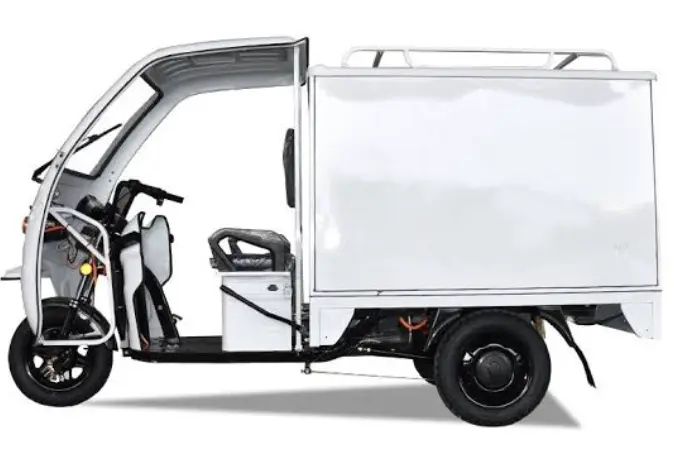
Enclosed Cargo Box Tricycle
An enclosed cargo box protects parcels, groceries, food products, electronics, and other goods from rain, dust, and road debris.
This type is often suitable for:
- E-commerce deliveries
- Express parcels
- Grocery distribution
- Food supplies
- Pharmacy deliveries
- Small retail distribution
An enclosed box can also improve security when the vehicle is parked or used in busy urban areas.
Flatbed Cargo Tricycle
A flatbed tricycle has an open rear platform that can carry large or irregular goods.
It is commonly used for:
- Agricultural products
- Building materials
- Beverage crates
- Gas cylinders
- Furniture
- Market goods
- Bulk merchandise
Flatbeds provide loading flexibility, but cargo should be secured properly with approved restraints and covered when weather protection is needed.
Dump Cargo Tricycle
A dump-body tricycle is designed for loose materials that need to be unloaded quickly.
Typical uses include:
- Sand and gravel
- Soil
- Agricultural materials
- Waste collection
- Small construction jobs
- Landscaping work
This configuration is best suited to heavy-duty work and should be chosen with attention to payload rating, hydraulic system quality, and chassis strength.
Passenger-Cargo Tricycle
Some tricycles combine seating with a limited cargo area. They can be useful for local service businesses that need to transport staff, tools, or small deliveries.
However, passenger and cargo capacity should never be exceeded. The operating layout must comply with local safety and transport requirements.
Electric vs. Fuel-Powered Delivery Tricycles
The power source affects route capability, daily operating cost, and maintenance needs.
Electric Tricycle for Delivery
An electric tricycle for delivery is often a strong choice for short-distance urban routes with predictable charging access.
Benefits may include:
- Low energy cost
- Quiet operation
- No tailpipe emissions during use
- Simple daily operation
- Suitable for dense urban areas
- Lower routine maintenance requirements than many engine-powered options
Important considerations include battery capacity, real-world range, charging time, cargo weight, hill climbing ability, battery warranty, and charging infrastructure.
Electric tricycles are often well-suited to neighborhood delivery, campus logistics, local retail distribution, and short-distance parcel routes.
Fuel-Powered Delivery Tricycle
Fuel-powered tricycles may be more suitable for longer routes, heavier cargo, rural areas, or locations with limited charging infrastructure.
Benefits may include:
- Fast refueling
- Long route capability
- Stronger support for some heavy-duty applications
- Practical operation in remote areas
- Familiar maintenance procedures in many markets
The correct engine size should be selected according to cargo weight, terrain, and daily mileage. An undersized engine may struggle on hills or under load, while an oversized engine may increase fuel use and purchase cost.
Payload Capacity Is Essential
A delivery tricycle should be selected by its rated payload, not only by cargo-bed size. A large cargo box does not necessarily mean the chassis, tires, suspension, brakes, and motor can safely carry a heavy load.
Before buying, calculate:
- Average cargo weight per trip
- Maximum expected cargo weight
- Number of deliveries per day
- Driver weight and onboard equipment
- Road gradients and surface conditions
- Required safety margin for daily operation
Overloading can reduce vehicle stability, damage the suspension, increase braking distance, accelerate tire wear, and create unsafe driving conditions.
Consider Road and Route Conditions
The best tricycle for delivery also depends on where it will operate.
Urban Delivery Routes
For crowded city streets, look for:
- Compact dimensions
- Tight turning radius
- Good low-speed handling
- Reliable brakes
- Enclosed cargo protection
- Efficient electric or low-fuel-consumption powertrain
Rural and Uneven Roads
For rural or rough-road delivery, prioritize:
- Strong chassis construction
- Higher ground clearance
- Durable suspension
- Suitable tire pattern
- Adequate torque
- Easily available maintenance parts
Hilly Routes
For hilly areas, choose a tricycle with sufficient power and torque for loaded operation. Battery capacity, motor output, gear ratio, and braking performance are particularly important for electric models.
Driver Comfort Supports Delivery Efficiency
Delivery work can involve many hours of driving each day. Driver comfort affects safety, productivity, and fatigue.
Useful comfort features include:
- Ergonomic seat
- Weather protection
- Clear visibility
- Easy controls
- Stable foot position
- Practical storage for documents and tools
- Good suspension
- Comfortable cabin space where applicable
A delivery tricycle should be easy to enter, operate, park, and load throughout a full work shift.
Maintenance and Spare Parts Availability
A low purchase price does not always mean a low total cost of ownership. Before choosing a model, confirm the availability of replacement parts, service support, tires, brake components, batteries, chargers, and other necessary electrical components.
A dependable tricycle for delivery should be designed for regular commercial use and be easy to maintain. Downtime can directly affect customer service and delivery income.
Quick Selection Guide
| Delivery Need | Suitable Tricycle Direction |
|---|---|
| Parcels and e-commerce orders | Enclosed cargo tricycle |
| Groceries and food supplies | Enclosed or insulated cargo body |
| Fresh produce and market goods | Flatbed cargo tricycle |
| Building materials and bulk loads | Heavy-duty flatbed or dump tricycle |
| Short urban routes | Electric cargo tricycle |
| Long-distance or rural delivery | Fuel-powered cargo tricycle |
| Mixed tools and service equipment | Enclosed or utility cargo tricycle |
Final Thoughts
The best tricycle for a delivery job is the model that matches the cargo, route, payload, energy source, and maintenance conditions of the business.
For lightweight urban deliveries, an electric enclosed cargo tricycle may be an efficient option. For heavy loads, long distances, or rough roads, a stronger fuel-powered flatbed or dump-body model may be more appropriate.
When choosing a tricycle for delivery, focus on rated payload, cargo-body design, stability, route conditions, operating cost, and service support. A properly selected commercial tricycle can help businesses improve delivery capacity, reduce operating pressure, and provide reliable local logistics.
For cargo tricycle and delivery-vehicle information, visit Auto Trikes.
Post time: 07-28-2026